What is taping?
Musculoskeletal problems are familiar to almost everyone. They can be serious illnesses or common everyday injuries, such as sprains, bruises, muscle pain after training or prolonged exertion. In such cases, taping is increasingly used.
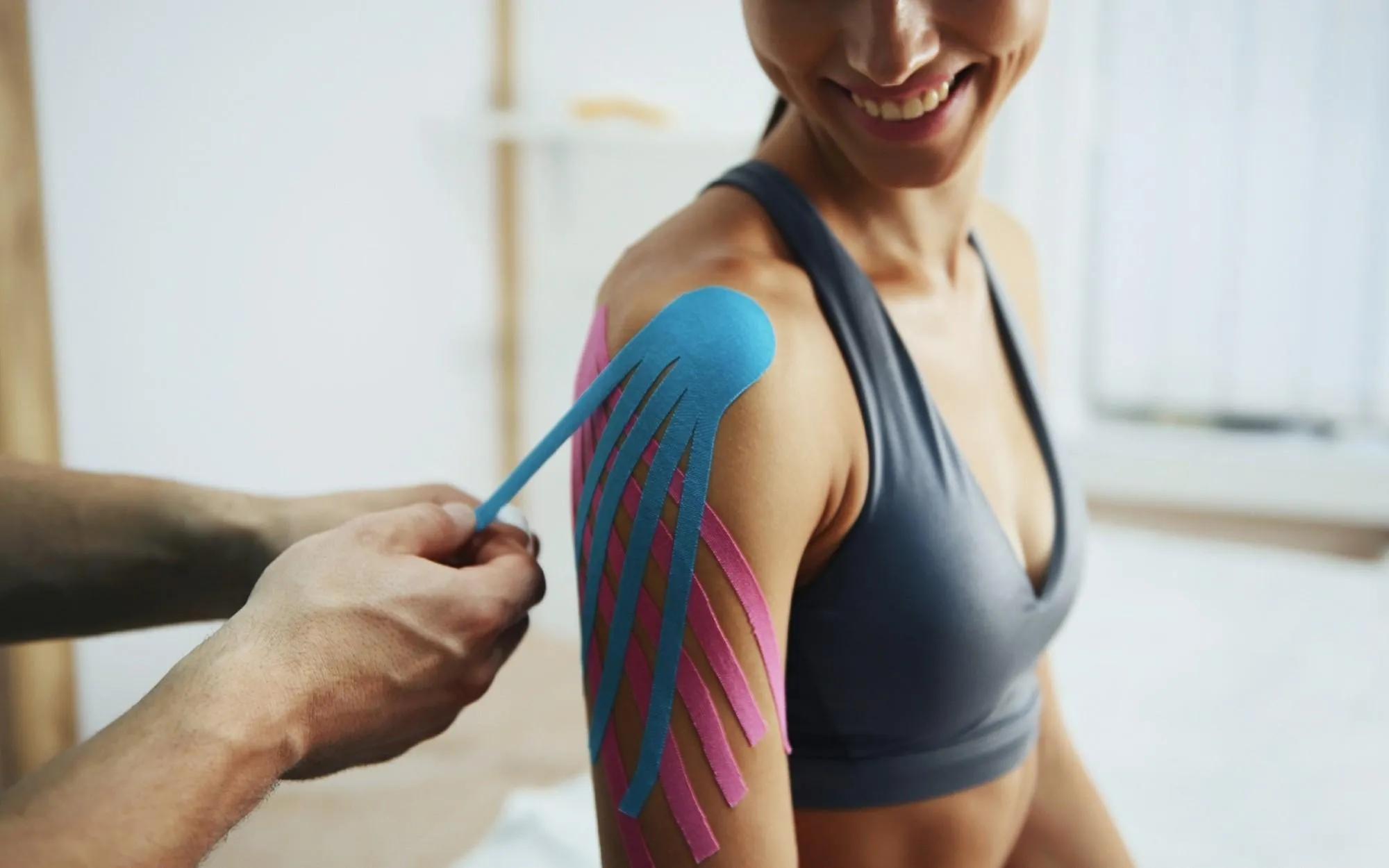
This is a method of supporting muscles and joints using special elastic tapes. They are glued to the skin using a certain technique and help reduce pain, accelerate recovery from injuries, improve blood and lymph circulation, and reduce the load on damaged areas of the body.
This technique was developed by Japanese chiropractor Kenzo Kase back in the 1970s. At first, taping was used mainly in sports medicine, but over time its effectiveness was appreciated in physiotherapy and rehabilitation. Today, taping can be seen not only on professional athletes, but also on ordinary people who want to recover faster after physical exertion or reduce pain in joints and muscles.
What is kinesiology taping and how does it work?
Taping is a technique of applying special cotton or synthetic elastic tapes with hypoallergenic acrylic adhesive to the body. They help normalize tissue functions, reduce swelling and inflammation, and restore mobility in areas with impaired muscle or joint function.
The main functions of kinesiology taping:
- Support for weakened muscles, reduce fatigue, pain, and the risk of spasms or overstretching.
- Improve blood circulation, reduce swelling, stimulate lymph flow, and accelerate tissue regeneration processes.
- Stabilize joints without losing their mobility.
Kinesio taping does not limit a person’s activity, but on the contrary, it allows them to move freely, while providing the necessary support exactly where the body needs it.
History of the method
The idea of creating kinesiology tape appeared in the 1970s thanks to the Japanese chiropractor Kenzo Kase. After one of the therapeutic sessions, he thought about how to make the effect of manual therapy longer lasting.
At first, he used classic sports tapes, but they rigidly fixed the body and limited movement. Then Kase began experimenting with elastic bands and realized that they could support muscles and joints, but at the same time not impair mobility.
Initially, this technique was used mainly by orthopedists and chiropractors. The real breakthrough came when Japanese volleyball players first used elastic tapes at the Olympic Games. This attracted the attention of people from all over the world to taping, and the technique quickly spread to sports medicine, physiotherapy and rehabilitation.
Types of kinesiology tapes
Modern kinesiology tapes, depending on the materials and purpose, are divided into several types.
Classification by material
Kinesiology tapes can be made of:
- Cotton. They are well breathable, comfortable in daily use and suitable for sensitive skin. Such tapes usually have a medium level of elasticity (about 140–160%).
- Synthetics (nylon or polyester). They are more resistant to moisture and have increased elasticity (up to 180%). Synthetic tapes are ideal for athletes and those who are actively involved in physical activity, as they retain their properties longer.
- Combined materials. They combine the properties of natural and synthetic fibers. Thanks to this, the tape simultaneously passes air well, has high elasticity and retains its properties for a long time.
Classification by purpose
By their purpose, tapes are divided into sports and kinesiological (rehabilitation or preventive).
Sports tapes are used to fix and stabilize joints, muscles and ligaments. They help to avoid injuries during intense loads, and are also used for temporary immobilization. Typically, sports tapes are applied for a short period of time, specifically during training or competitions.
Kinesiotapes, unlike sports tapes, perform other tasks. They stimulate blood circulation and lymph flow, reduce swelling, relieve pain, support muscles and help distribute the load correctly. Due to their elasticity, kinesiology tapes do not restrict movement, they can remain on the body for several days in a row. They are used in rehabilitation, for bruises and sprains, as well as for the prevention of injuries.
Indications for the use of kinesiology taping
Kinesiotape has a very wide scope. Due to its versatility, this technique helps to cope with sports injuries, chronic diseases or the consequences of neurological disorders.
Sports Injuries
Kinesiotapes are widely used in sports for the prevention and treatment of injuries. In case of muscle and ligament sprains, they stabilize the affected area, reduce the load on the damaged tissues, relieve pain and accelerate healing. In case of bruises, tapes improve blood circulation in the hematoma area, reduce swelling and promote faster resorption of bruises. In addition, they are often applied before training or competitions to support joints and muscles, which reduces the risk of repeated injuries.
Musculoskeletal diseases
The technique is also effective in diseases of the musculoskeletal system. In case of arthritis and arthrosis, tapes reduce the load on the joints, reduce pain and improve mobility. In case of muscle spasms, they help relax overstrained areas, restoring normal blood circulation. Kinesiotapes are also used for posture problems. They support the muscles of the back and shoulder girdle, helping to correct stoop or scoliosis.
Neurological disorders
In neurology, kinesiotherapy is used to normalize muscle tone. It helps with hypertonia (increased tension) and hypotonia (muscle weakness), which are accompanied by various neurological conditions. The technique is also used during rehabilitation after a stroke. The tapes support weakened muscles, stimulate blood circulation and contribute to the gradual restoration of motor functions.
Lymphatic disorders
Kinesiotape effectively fights disorders of the lymphatic system. Tapes applied using a special technique lift the skin, creating space for lymph drainage. This reduces swelling after injuries, surgeries, or chronic conditions. For best results, the technique is often combined with lymphatic drainage massage, which you can sign up for in our Seizó salon.
Contraindications and limitations
Kinesio taping has certain contraindications and limitations that must be considered before the procedure.
Absolute contraindications
Absolute contraindications exclude the possibility of using kinesiotherapy due to the high risk to health. These include:
- Acute inflammatory processes and skin infections.
- Oncological diseases.
- Thrombosis and thrombophlebitis.
- Allergy to tape materials.
- Acute injuries with open fractures or bleeding.
Relative contraindications
There are conditions in which kinesiotherapy is possible, but only after consulting a doctor. These include:
- Sensitive or damaged skin.
- Chronic diseases in the acute stage.
- Pregnancy in the 1st and 2nd trimesters.
- Acute undiagnosed pain in muscles or joints.
Kinesiotaping also has age restrictions. It is not recommended for children or the elderly.
Tape application technique
To achieve maximum effectiveness of kinesiology taping, it is very important to apply the tapes correctly. They are placed taking into account the anatomical features of a specific area of the body and the nature of the problem.
Knee taping
The technique of knee taping depends on the specific problem. For joint pain, tapes are applied in Y- or I-shaped techniques around the kneecap. This allows you to stabilize the joint, reduce pressure on ligaments and muscles, and also reduce pain. Usually the tape is stretched by 20–30%.
For instability of the patella, a cross-shaped fixation technique is used. Tapes are applied around the kneecap with a stretch of 30–50%. This allows you to fix the patella in the correct position and avoid its displacement.
In preventive taping for athletes, a light spiral application is made around the knee with minimal stretching of the tape (10–20%). It helps support the joint during training or competition, reduces the risk of overload and injuries, while maintaining full range of motion.
Ankle taping
When spraining the ankle ligaments, the tapes are glued in the shape of a “figure eight” from the foot to the shin with a stretch of 30–40%. This reduces the load on damaged tissues, reduces swelling and promotes faster recovery.
For flat feet, the tapes are stretched by 20–30% and placed along the arch of the foot and around the shin. They support the longitudinal or transverse arch of the foot, helping to reduce fatigue and pain while walking.
For heel spurs, the tapes are placed from the heel to the midfoot with a stretch of 40–50%. This technique reduces the load on the plantar fascia, reduces pressure in the heel area and improves blood circulation.
Customer reviews
Дякую , спеціалістам Тетяні (подолог) та Ірині за виправлення всіх недоліків попередніх майстрів 🙌 Я отримала дійсно кваліфіковану послугу 🫶 Дівчата поцікавилися які в мене побажання і виконали їх у відведений час . Допомогли обрати для мене колір покриття, зробили укріплення))) Я дуже задоволена ☺️
все на вищому рівні! від смачного чаю в неймовірно гарному посуді до сервісу та стильного інтерʼєру! 💓 ви нова любов!
Масажист Кирило- просто супер! Дякую!
Дякую дівчата за вашу роботу! Окрема подяка майстру Ірині, уважна, приємна і старанна дівчина🤩❤️
Даша суперська, останній манік відносився ідеально🫶🏼
Дівчата ,ви круті ,неймовірна крута атмосфера ,команда майстрів неймовірні ♥️
Дівчата молодці, знайшли до мене підхід (так вийшло що я вибагливий клієнт), поки ходила до майстра-подолога Тетяни (дає гарні рекомендації, що допомагають) та майстра Ірини (швидко та якісно виконує послуги)
Дякую вам велике! Оля на Таня зробили нам з подругою супер вечір і супер нігтики ❤️